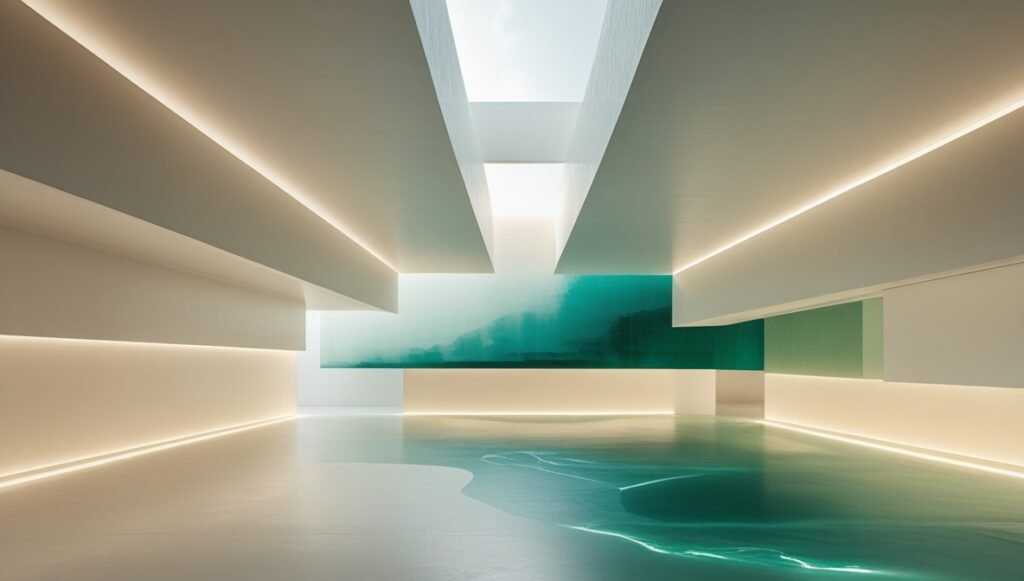

The way we observe, reflect, and approach the world shapes our actions and their outcomes. True creators transcend the tangible “form” to perceive the “emptiness”—an underlying order beyond appearances, interwoven with the tangible, weaving the invisible and visible into a meaningful whole. Most people fixate on “form”—the concrete shapes, data, or actions—overlooking the essence of “emptiness.” Yet, in certain realms, it is this “emptiness” that holds the key to mastery and brilliance.
In spatial design, architects who focus solely on buildings and structures, their minds filled with bricks and beams, rarely create awe-inspiring works. Visionary designers first see “emptiness”—the flow of space, the tension of relationships, akin to the open courtyards of Chinese architecture or the serene voids of Tadao Ando’s light-filled designs. They treat “emptiness” as a hidden thread, organizing the tangible to find its rightful place, crafting a harmony of form and void. Mere piling of “form” stifles a space’s breath, rendering it lifeless
The stock market tells a similar tale. Most chase price charts and market swings, caught in the thrill of red and green fluctuations, yet often lost. Investment masters, however, see “emptiness”: a company’s intrinsic value, its future trajectory, the pulse of human psychology. Unswayed by market noise, they anchor decisions in the logic of “emptiness”—comparing value to price—and profit by leveraging others’ focus on “form.” Thus, investing becomes an art, not an emotional gamble.
On the soccer pitch, virtuosos embody this wisdom. Spectators marvel at dazzling dribbles or goals—the “form”—but elite players see “emptiness”: gaps in timing, openings in positioning, the unguarded net. They orchestrate space, winning through the invisible. Fans cheer the spectacle, yet rarely glimpse the path of “emptiness.”
As the Diamond Sutra puts it : “To see beyond forms is to see the Tathagata.” “Emptiness” is not nothingness but a deeper law, grasped through the heart’s insight, like a smile upon picking a flower. Yet, while “emptiness” is the soul of creation, its fruits must manifest as “form” to serve and resonate with the many. A building’s void must become livable space, an investment’s value must yield returns, a soccer gap must lead to a goal. Without the lens of “emptiness,” creation risks becoming mere accumulation—form without spirit. Without grounding in “form,” lofty insights remain inaccessible to most.
How does one enter the state of “emptiness”? Through deliberate practice: architects sketch spatial flows, investors study business essence and human nature, players analyze off-ball movement. In a world dazzled by sensory overload—colors and sounds that blind and deafen—the perspective of “emptiness” unveils order amid chaos. It enables us to craft meaningful “form,” avoiding the trap of becoming mere consumers or consumed in a materialistic age.