
“Wealth isn’t luck—it’s freedom, leverage, and time. Break society’s slow-lane trap and race to your future.”
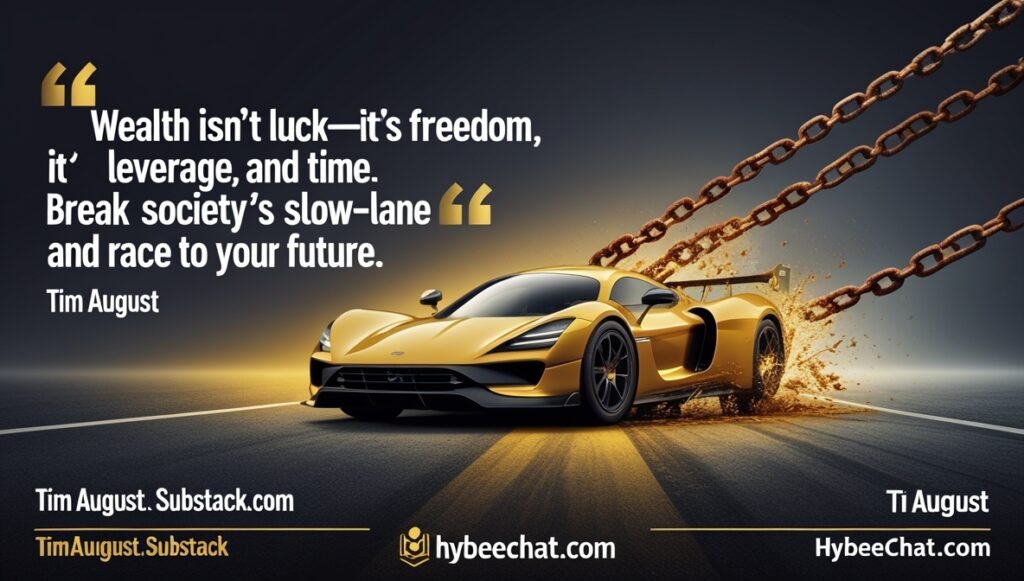
Wealth isn’t a straight path—it’s a race with wildly different tracks. Entrepreneurs, investors, and everyday workers run on separate lanes, each with its own speed, freedom, and payoff. These gaps come from how much control you have, how you leverage opportunities, and what the world throws at you. Yet, society often cheers for the slowest lane while side-eyeing those who build wealth. This essay breaks down these tracks through time and scale, calls out the absurdity of our biases, and offers a clearer way to think about wealth.
Time: Who Controls the Wheel?
- Entrepreneurs: Driving Fast, Steering Free
Entrepreneurs and business builders are the racecar drivers of wealth. They hold about 80% of the wheel, picking their projects, customers, and partners. This freedom lets them test ideas fast, with a feedback loop of 6 months to 3 years—half a year to see if something clicks, three years tops to know if it’s solid. Once they hit their stride, they sprint in small, smart steps, tweaking and scaling their vision over a decade or more. Their ability to pivot and push forward gives them a head start in a fast-moving world. - Investors: Half in Control, Riding the Market’s Waves
Investors are like sailors, with about 50% control over their course. They pick promising companies or projects but depend on market tides and other people’s hustle. Their results show up in 3 to 5 years, with 3 years as the quickest check-in. Their wins come from sharp market reads and smart bets, but storms—like economic dips—can throw them off. They’ve got leverage through money, but they’re not fully in the driver’s seat. - Workers: Stuck in Someone Else’s Car
Most workers feel like they’re giving 80% effort, but they control maybe 20% of their wealth-building path. They’re passengers in someone else’s business model, stuck navigating office drama or playing a small role in a big machine. Their progress takes 3 to 10 years to measure, with 5 years as a shorter benchmark. High-skill workers in fields like tech or finance might snag bigger rewards through bonuses or stock options, but for most, hard work gets watered down by the system, tied to a slow, steady paycheck.
Time boils down to freedom and leverage. Entrepreneurs speed ahead by building their own systems, investors ride capital’s waves, and workers are boxed in by someone else’s rules. But pinning exact numbers like 80% or 20% oversimplifies things—top workers can have more sway, and entrepreneurs face brutal odds, with about 90% of startups crashing within 3-5 years.
Wealth: Leverage Makes or Breaks the Game
- Entrepreneurs: Skyrocketing with Big Bets
Stories of overnight millionaires light up the headlines. Entrepreneurs use leverage—think innovation, networks, or market savvy—to multiply their wins. Over 10 years, they might see 10x, 100x, or even bigger jumps, rewriting the rules and cashing in on what people want. But it’s a high-stakes gamble: most startups flop due to bad timing or empty pockets, a risk that’s easy to gloss over. - Investors: Beating the Crowd
Investors aim to outrun the economy’s average or 90% of other players by picking winning stocks, startups, or funds. Over a decade, they could double, triple, or even 10x their money, leaning on sharp insights and patience. For example, index funds average 7-10% yearly returns, beating inflation, but the best investors do better. Still, market crashes—like 2008 or 2020—can wipe out gains. - Workers: Grinding for Steady, Small Wins
Most workers’ wealth grows slower than the economy’s average. In good times, they might double their savings in 5 years or see a few times more in 10. But when things go south—like layoffs in 2020—they’re the first to take the hit, barely holding onto what they’ve got. Some in high-paying fields like tech or finance can match investor-level gains with stock options or raises, but most are stuck in a slow grind, tethered to flat paychecks.
Wealth gaps come down to leverage. Entrepreneurs scale up by creating systems, investors grow through smart bets, and workers plod along with little to amplify their efforts. But hyping up 100x entrepreneurial wins ignores the graveyard of failed ventures. And the economy—boom or bust—hits each track differently, a point that needs more spotlight.
Society’s Blind Spots: Why We Judge the Winners
Society loves to cheer for the “stable” worker while throwing shade at entrepreneurs and investors, calling them greedy or jealous. It’s a head-scratcher. Wealth builders take big risks—failed startups, tanked investments—and their rewards match their guts and smarts. But the distrust runs deep: skyrocketing inequality, shady business moves like monopolies, or speculative bubbles stir up resentment. Cultural habits, like valuing security over risk, also dampen our love for bold moves. Blaming it all on “envy or ignorance” is too easy—it misses the bigger picture of unfair access and systemic flaws.
Ways to Fix the Narrative:
- See All Sides: Workers choose stability for good reason—less risk, steady pay. But entrepreneurs and investors aren’t just lucky; they face huge flops too.
- Back It Up: Numbers tell the story better—90% of startups fail, index funds grow 7-10% a year. Real examples ground the hype.
- Break Down Barriers: Wealth tracks aren’t open to all. Better education, startup funding, or affordable investing (like apps for small investors) could level the field.
- Play Fair: Wealth creators should do right by others—fair wages, ethical investing—not just chase profits.
The fast and slow lanes of wealth show how freedom, leverage, and time shape your shot at financial freedom. Entrepreneurs zoom ahead by building their own rules, investors sail past the average with smart bets, and workers trudge along, boxed in by the system. To break out, pick a high-leverage path, think long-term, and embrace the risks. But switching lanes isn’t simple—it takes money, know-how, and grit. Society needs to rethink its grudges, make education and opportunities more accessible, and balance bold ideas with fairness. Only then can we all race toward a richer future.